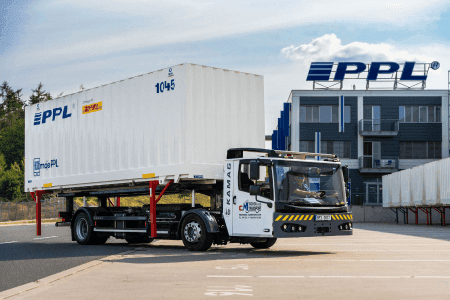
PPL, a leading transport company, is celebrating a landmark anniversary – it has been delivering shipments since 1995. It started out mainly as a service carrying parcels between businesses, at a time when delivery services were still a novelty on the Czech market. Today it has long held a firm place on the market and among customers, and it has won the Most Trusted Brand title five times in a row.
Over the past 30 years the company has grown and gone through many changes. “In three decades we have come an enormous way as a company and adapted to a world that is changing fast around us. We have had to respond to the rise of modern technologies, to digitalisation and to the COVID-19 pandemic, and to place greater emphasis on doing business responsibly and considerately towards the world around us. As our services, Czech e-shops and domestic e-commerce have grown, the volume of shipments PPL carries every year has changed significantly too,” says Petr Horák, CEO of PPL CZ.
In its early days the company carried around 300,000 shipments a year across Czechia; today it can handle almost three times that volume in a single day of the pre-Christmas season. Thanks to its connection to the DHL network, it can also deliver shipments throughout Europe. It was the link-up with its parent company DHL in 2006 that opened a new era for PPL: it created opportunities in international transport and, together with growing demand for cross-border shipments, contributed to further growth.
“Trying to sum up PPL's first 30 years would fill at least one very thick book, probably two. So what I mainly want to say here is how proud of PPL I am. Proud of everyone who stands behind it and who stood behind it in the past, including my dad when it was starting out. Our blue heart with a passion for parcels has been beating for 30 years, and I only wish that the passion never fades and that the heart keeps going at full tilt for at least twice as long again,” says Petr Horák.
Growth, digitalisation and automation
When PPL was founded 30 years ago it started out with seven regional depots; today its network has 26 of them, plus two modern central hubs. The newest of these, opened in Hradec Králové in 2022, is equipped with state-of-the-art machinery and environmentally friendly technologies that help PPL process an ever-growing number of orders. Its fully automated sorting line, for example, can handle up to 500,000 shipments a day.
“When my father and his colleagues were getting the service off the ground thirty years ago, there were no automated belts available; parcels were pushed by hand along simple roller conveyor systems. It was more of a human chain. Today we are supported by cutting-edge technology that nobody even dreamed of back then, and that is moving our services forward and speeding them up by leaps and bounds,” recalls Petr Horák.
The company is keeping up with rising demand for its services thanks in part to process automation, digitalisation and the expansion of its network and of the range of pickup point types. PPL currently has more than 6,700 of them across all regions of Czechia.
PPL as an employer
In 1995, when PPL was starting out, it had around 100 employees. Today the company has more than 1,500 staff and works with over 2,000 drivers across the country. “PPL is where it is today only thanks to our employees and drivers. I value everyone who has passed through our company over those 30 years and lent a hand, and especially those who have been with us from the very beginning,” sums up Petr Horák.
For the way it looks after its people and its corporate culture, the company received the prestigious Top Employer award this year for the fourth year in a row. The award assesses areas such as the quality of recruitment, corporate culture, benefits and other key areas. PPL also regularly retains its Great Place to Work certification.
PPL as part of sustainable logistics
Sustainability is playing an ever greater role in logistics, and PPL is therefore taking concrete steps to be gentler on the environment. It sources 100% of its electricity from renewable sources, it has begun fitting its depots with solar systems, and by the end of the decade it wants at least 60% of its fleet to consist of electric vehicles. It already operates around 140 alternatively powered vehicles.
“Times are changing, and PPL is changing with them. What stays the same is our passion for the industry and our determination to do our work to 100%. I am already looking forward to what the coming years will bring, and I am certain that together we will manage it,” concludes Petr Horák.