
How online withdrawal will work
The purpose of the new rules is to make it easier for customers to withdraw from a contract concluded at a distance. The obligation applies to all e-shops, providers of digital content and recurring services, and marketplace sellers.
Customers must be given these ways to withdraw from a contract:
➡️ in their customer account, with the specific order,
➡️ through a link in the transactional e-mail,
➡️ through a link in the website footer.
One click is not enough, a confirmation must follow
Clicking “Withdraw”, “Return goods” or a similar button must not cancel the order straight away. A second step has to follow, in which the customer confirms that they really do want to withdraw from the contract. This is meant to prevent orders being cancelled by accident. At the same time, customers must not be forced to give a reason for the return, they should only fill in the necessary details, and they must be able to return either the whole order or just selected items.
The button must be available from the order confirmation onwards
The statutory fourteen-day period starts to run only once the goods are delivered, but customers can also withdraw before delivery. The option to withdraw should therefore be active from the moment the order is confirmed. For shipments split into several parts, the period starts to run on delivery of the last part.
After withdrawing, the customer must automatically receive a confirmation
The confirmation must come on a durable medium, typically by e-mail. It must state the date and exact time of the withdrawal, list the items being returned, summarise the request and explain how and where to send or hand over the goods.
☝️ Automatic messages about further status changes are recommended as well, for example once the shipment has been received, once its processing has started or once the refund has been made. Missing information about the status of a return is a frequent source of customer support enquiries.
The button alone is not enough
The new rules will not show up only in the returns “button”. For all the steps to follow on from each other properly, the related documentation, customer communication and internal processes will need to be adjusted too. E-shops should therefore check:
➡️ their terms and conditions and privacy policy,
➡️ the withdrawal form,
➡️ transactional communication,
➡️ processes for registered and unregistered customers,
➡️ internal processing of returns and refunds.
Failing to meet these obligations can bring a fine of up to CZK 5 million.
The option and the method of return can shape the purchase surprisingly early
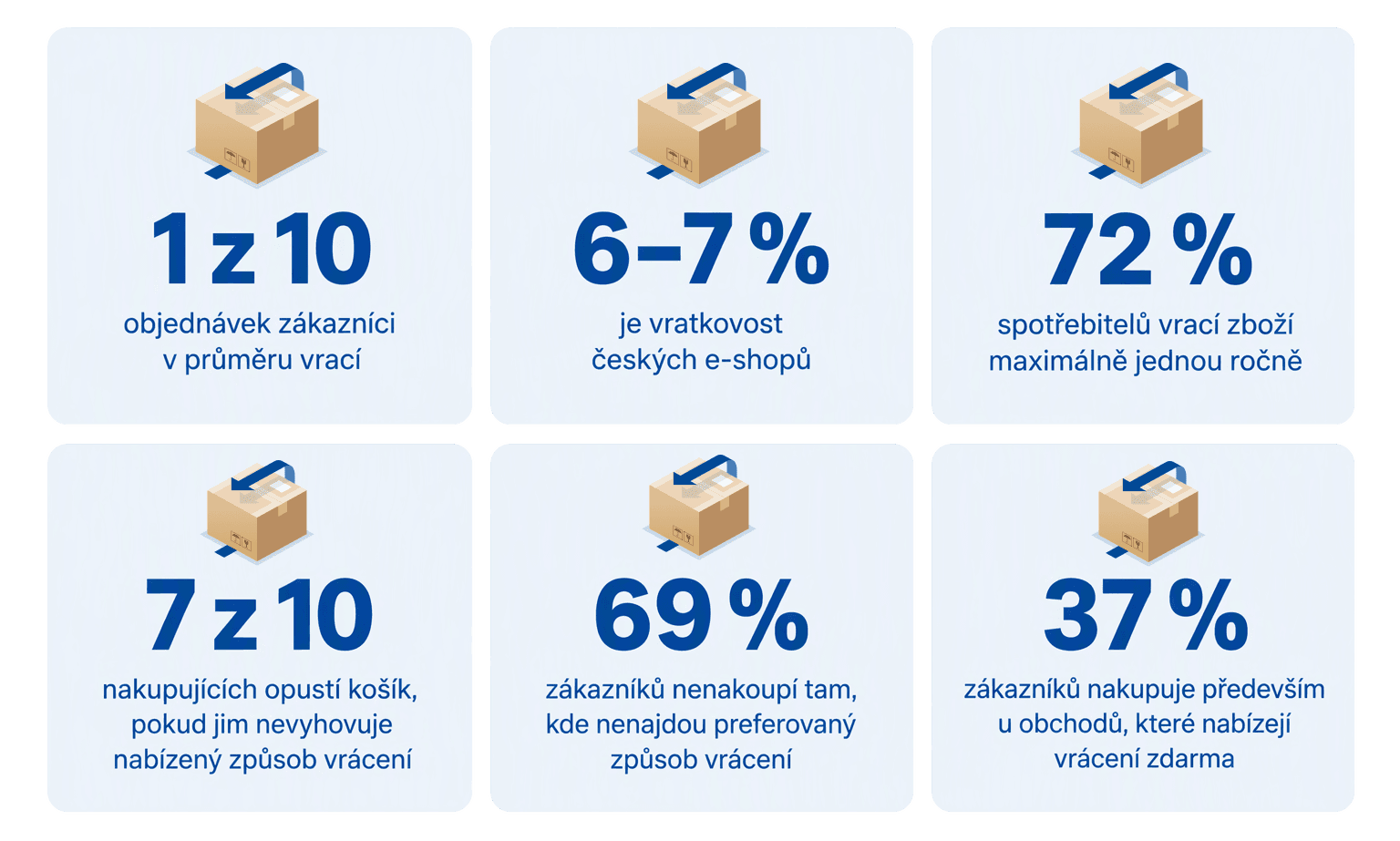
Even though customers may not return goods often, or at all, an easy return makes the whole shopping experience more pleasant – and leads them to conversion. 7 out of 10 shoppers abandon their basket if the return method on offer does not suit them. So don't let your customers “stumble” just before the finish line.
The best return is one the customer can handle alone
The ideal returns process is as self-service as possible: the customer easily picks the items to be returned and the transport method – ideally without having to print anything – follows the status of the return online and keeps receiving the important information.
Boxes, labels, QR codes
That independence shows in the way return shipments are sent, too: 48% of Czech consumers most often return goods through a box, 54% prefer a return label prepared in advance and 31% a return QR code. Clearly, the more they can handle themselves, the more convenient returning goods is for them.
Give automation the green light
Automation is an advantage for you as an e-shop as well: you can manage every case in a single system, with no manual re-typing between channels. On top of that, as an e-shop you can gather feedback and ask customers why they are returning goods. The data may point to an unclear product description, a problem with sizing or photos that do not match customers' expectations.
For the customer, automation means fewer steps and an easier drop-off. For the e-shop, it means a clearer process that can significantly simplify the whole administration and cut the number of customer support enquiries.
How PPL can help with returns
Easy returns also depend on the way a shipment is dropped off. With the PPL network of more than 6,200 boxes, customers can return shipments in whatever way suits them. And thanks to the labeless solution from PPL, they do not have to print a label at all. To drop a shipment off at the box or pickup point of their choice, or with a driver, all they need is a QR code or a Smart PIN.
What is worth starting on right now?
➡️ Map your current withdrawal and returns process
➡️ Review customer accounts, transactional e-mails and purchases without registration
➡️ Check your terms and conditions and the related documentation
➡️ Connect online withdrawal with your internal returns processing
➡️ Set up automatic notifications about status changes
➡️ Offer drop-off without any printing
➡️ Track return reasons, processing speed and customer satisfaction
The new rules bring obligations. At the same time, they give e-shops a chance to set returns up so that they are simpler for customers and for the people who process them.
💡And where does AI come into all this?
31% of Czechs already use AI assistance when shopping. Among customers under 29 it is almost half. Genuinely agentic shopping is just around the corner.
The way the return process is set up, and how well, is also one of the parameters AI tools use when picking e-shops for customers.